
The Club Badge Explained
Club Colours
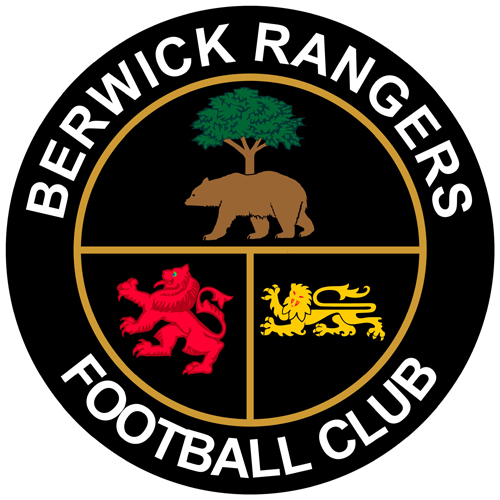
The gold circle on the black background represents the football club and its colours.
In the early days of association football teams did not have standardized matching kits. Players frequently wore their own clothes or mismatched shirts, so teams used different coloured or styled caps on the pitch to tell opposing sides apart. Matching full kits became standard by the late 1890s and the wearing of caps soon disappeared.
Berwick Rangers were gifted black and yellow "coolie" hats (an oriental-style tasselled hat) for their opening match against Alnwick Working Men's Cub in early 1884 and thereafter adopted black and yellow as the Club's official colours. Vertical stripes were a very popular design on football shirts at the time and as such the club followed in black and yellow.
Over the years, yellow became synonymous with the colour gold hence the club's colours of black and gold.
A Town on the Border
The vertical gold line inside the circle represents the border between England and Scotland.
The horizontal gold line represents the town betwixt and on its own.
Berwick upon Tweed is a unique place, sitting on the border between England and Scotland with a rich and fascinating history. It was part of the ancient Kingdom of Northumbria from the late fifth century to 1018 before changing hands between England and Scotland 14 times. However, in 1482 it was retaken for the last time and given the special status of "being in England but not part of it" until 1974 when the Wales and Berwick act was repealed by parliament and the ruling fully incorporated the town into England.
The Bear & Tree
The bear and the wych elm tree are an ancient symbol of Berwick as seen on the town's medieval seals from at least the 13th century.
It is a heraldic canting device – a visual pun on the name Berwick, with the bear representing "bear" and the tree, a wych elm, giving "bear + wych".
The name shows the town's Anglo-Saxon origins, being a settlement trading in barley – from "bere" (barley) and "wic" (village).
The bear was traditionally shown as muzzled and chained, although the club badge now shows it without.
The Scottish Lion Rampant
The red lion rampant represents Scotland. The lion rampant is the traditional heraldic symbol of Scottish royalty and has been associated with Scotland for centuries. Its inclusion on the Berwick Rangers badge recognises the town's historic links with Scotland as a former royal burgh.
The English Lion
The gold lion passant guardant is the heraldic lion associated with England. Unlike the Scottish lion which stands upright (rampant), the English lion walks with its head facing the viewer (passant guardant). Its inclusion reflects Berwick's unique position on the border and the town's historic links with England.
Badge Usage
Berwick Rangers have always used the bear and tree, in various designs, as the the official club badge.
The Club first introduced a proper club crest on their shirts in season 1989/90, featuring the bear and tree from the town's historic arms. Before this, the club used the initials BRFC diagonally from 1980/81 to 1983/84 and season 1986/87.
For season 1994/95 the club added the Scottish lion rampant and English lion passant guardant to complete the badge.
The badge artwork was redesigned in 2008 and used on the team shirts from the start of season 2010/11. This remains the club's badge today.